SodaSlim Official Website › Ingredients
IngredientsSodaSlim Ingredients: the five names and what each one is for
SodaSlim names five ingredients: caffeine anhydrous, green coffee bean extract, raspberry ketone, garcinia extract and green tea extract.
The label carries no Supplement Facts panel, so no milligram figure is available for any of them. This page prints each name beside the daily amount its own published research used, which is the only number that can honestly sit in that column.
Five cards, in the order the bottle's own graphic prints them, each with the trial evidence and the dose that evidence used.
The five ingredients in SodaSlim, one card each
Caffeine Anhydrous
trial ceiling 400 mg/dayThe first name on the bottle's own graphic and the anchor of the formula. Anhydrous simply means dried, so this is ordinary caffeine in powder form rather than a different compound.
What it does is well established. A crossover in the American Journal of Clinical Nutrition measured whole-body energy expenditure after a single drink carrying 77 mg of caffeine with 615 mg of catechin and recorded a rise in cold-induced thermogenic capacity. A placebo drink with 82 mg of caffeine alone produced a smaller response, which is the clearest illustration available that caffeine and catechins do different jobs in the same glass.
Appetite is the second half. A controlled trial in Appetite gave beverages containing soluble fibre, caffeine and green tea catechins and recorded lower hunger and less energy eaten at the next meal.
The number to hold on to is the ceiling. Health Canada’s review of caffeine and human health concluded that up to 400 mg a day is not associated with adverse effects in healthy adults, and set 300 mg for women of reproductive age. Since this label gives no figure, the capsule has to be counted as an unknown against that budget.
Green Coffee Bean Extract
Coffea arabica, unroasted beantrials at CGA 500 mg/dayGreen coffee is ordinary coffee that has not been roasted. Roasting destroys much of the chlorogenic acid in the bean, so an unroasted extract is the way to deliver it, and chlorogenic acid rather than caffeine is what this row is on the label for.
A 2023 systematic review and meta-analysis pooled randomised trials of green bean coffee extract and concluded that chlorogenic acid at 500 mg a day lowers body weight. That is the figure worth carrying: not a quantity of extract, but a quantity of the active inside it, and most commercial extracts are standardised to somewhere near half chlorogenic acid by weight.
The older evidence is weaker and should be described as such. The 2011 pooled analysis found a mean difference of 2.47 kg against placebo across three trials, and its own authors judged every included study to be at high risk of bias and called for more rigorous work.
Two further reviews look at what else the extract does: a review of cardiovascular risk factors and a dose-response analysis of blood pressure and heart rate. Neither is a reason to take the capsule, and both are worth a glance by anyone who already watches their blood pressure.
Raspberry Ketone
no human dose existsThis is the name on the label with the widest gap between reputation and evidence, and the honest thing to do with it is say so plainly and then explain why.
Raspberry ketone is the aroma compound that gives raspberries their smell. It is a food flavouring with a long history of safe use at flavouring amounts. What it does not have is a human trial of its own. Searching the published literature for a study that gave raspberry ketone to people, on its own, at a stated dose, returns nothing.
The two human papers that name it both tested it inside multi-ingredient products. An eight-week trial used a product containing eight ingredients alongside it, and a later exercise and diet trial did something similar. Neither can tell you what the ketone contributed, because neither was designed to.
The single-ingredient work is in animals. A 2017 study in Food & Function fed raspberry ketone to mice on a high-fat diet and found it failed to reduce adiposity beyond the effect of the animals simply eating less. That is a real finding, and it points at appetite rather than at fat metabolism.
So: a pleasant, safe, food-grade compound with a good story and no human dose behind it. It is on this label, this desk is not going to pretend otherwise, and nobody should buy this capsule for this row.
Garcinia Extract
Garcinia gummi-gutta, rindtrials at HCA 1,500 mg/dayGarcinia is the rind of a small tropical fruit, and hydroxycitric acid is the compound extracted from it. The proposed mechanism is competitive inhibition of an enzyme involved in turning carbohydrate into fat, which is a neat story and has been told for thirty years.
The definitive trial is a 1998 randomised, double-blind, placebo-controlled study in JAMA. It ran twelve weeks, randomised 135 overweight adults, gave hydroxycitric acid at 1,500 mg a day against placebo with a high-fibre, low-energy diet in both arms, and found no difference in body weight or fat mass. That is a properly powered negative result at a dose far above what a five-ingredient once-daily capsule could plausibly carry.
An appetite study in Physiology & Behavior looked at the satiety half of the claim directly, and a 2012 safety and efficacy review covers the wider literature. The picture across all of it is of an ingredient whose fame has outrun its results.
Garcinia is also the ingredient on this label with the most serious safety literature, which is covered on the side effects page rather than here, because this page is about what the ingredient is for.
Green Tea Extract
Camellia sinensis, leafsignal around EGCG 300 mgThe last of the five and the one with the largest evidence base. Green tea extract is on this label for its catechins, of which epigallocatechin gallate is the most studied.
The Cochrane review of green tea for weight loss took in randomised trials of at least twelve weeks in overweight or obese adults. The twelve-week floor is the part worth noticing even before the conclusions: this is a category that expects to be judged over months, and it is the reason the timeline on this site runs in weeks rather than days.
A meta-analysis of EGCG and energy expenditure found the metabolic-rate signal appearing around 300 mg of EGCG, which is the figure to set against any green tea extract label. A systematic review of green tea and body composition and a meta-analysis of leptin and ghrelin fill in either side of it.
One result complicates this particular formula. The 2009 meta-analysis reported that the catechin effect was attenuated in people whose habitual caffeine intake was above 300 mg a day. A capsule that combines catechins with caffeine anhydrous is standing on both sides of that finding at once, and a reader is entitled to know it.
What the SodaSlim label prints, and what it leaves open
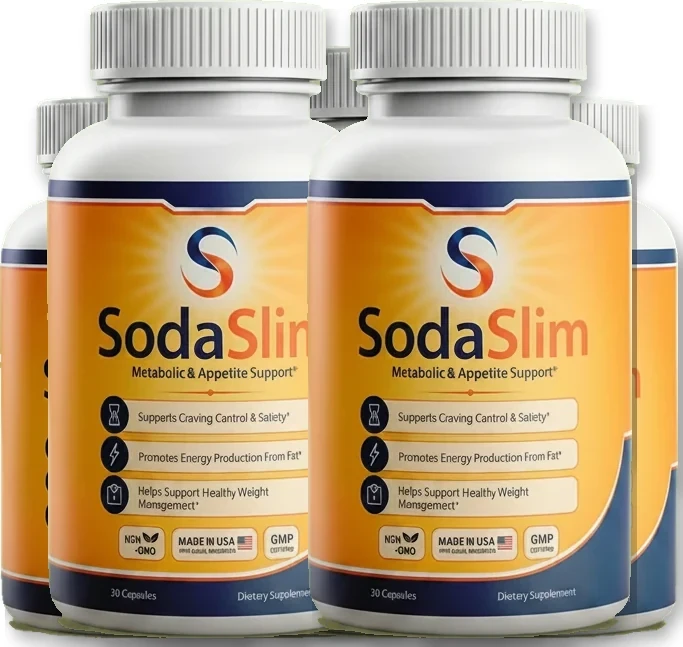
| Field | As printed on the artwork |
|---|---|
| Brand | SodaSlim |
| Strapline | Metabolic & Appetite Support |
| Count | 30 Capsules |
| Category | Dietary Supplement |
| Seals printed | Non-GMO · Made in USA with global ingredients · GMP Certified |
| Supplement Facts panel | Absent from every piece of artwork in this batch |
Read off the bottle front and the seller's ingredient graphic on 19 September 2026.
A front label sells and a panel informs, and only one of those two is on this bottle. The count is there, the five names are there, the seals are there, and the quantities are the open question.
This desk fills that gap with research rather than with an estimate. The table below is the same one that appears on the home page, and it is the spine of the argument: five ingredients, five real literatures, and five daily amounts that a once-daily capsule would have to be large to reach.
The SodaSlim amounts set against the research
Read the right-hand column as a specification rather than as a criticism. If a buyer knew that this capsule carried 500 mg of chlorogenic acid, the green coffee row would be settled. If they knew it carried 300 mg of EGCG, the green tea row would be settled. The table exists so that the questions worth asking the seller are obvious.
Two rows can never be settled that way. Raspberry ketone has no human dose to compare against, and garcinia has a dose that was tested properly and did not separate from placebo. Those are different problems and they deserve different answers: one is a gap in the literature, the other is a result.
Four things absent from the SodaSlim label
Four things a buyer commonly asks about are absent from the five names, and saying so is useful rather than negative.
There is no green coffee decaffeination claim, so the green coffee row carries its own caffeine on top of the anhydrous row. There is no prescription compound of any kind: nothing on this label is a GLP-1 medicine, a diuretic or a laxative. There is no proprietary blend name hiding a longer list, because there is no panel to hide one in. And there is no vitamin or mineral content, so this capsule is not doing a multivitamin's job alongside its own.
That last point matters for anyone taking other supplements. A five-name stimulant formula stacks with other stimulant formulas and does not duplicate a multivitamin, so the arithmetic to do before adding it is caffeine arithmetic.
SodaSlim ingredients: what readers ask
How many ingredients are in SodaSlim?
Five are named on the bottle and on the seller's ingredient graphic: caffeine anhydrous, green coffee bean extract, raspberry ketone, garcinia extract and green tea extract. The graphic's own footer repeats the count.
How much caffeine is in a SodaSlim capsule?
The artwork does not give a figure. Nothing on this site estimates one, because a plausible number printed beside an ingredient reads exactly like a measured one. Treat the capsule as an unknown addition to the day's coffee and tea.
Is there a Supplement Facts panel on the SodaSlim bottle?
Not on any artwork supplied with this batch. The front label carries the brand, the strapline, three benefit lines, three seals and the count. The ingredient graphic carries the five names over photographs of the raw materials.
Is SodaSlim suitable for vegetarians?
The vendor's seal artwork includes a vegetarian mark, and the label itself does not say what the capsule shell is made from. Those two facts do not settle each other, and testing and quality is where that is discussed rather than glossed.
Who publishes this SodaSlim website?
Eighteen sources, one cluster per ingredient, each read before it was cited.
- Yoneshiro T, Matsushita M, Hibi M, et al. Tea catechin and caffeine activate brown adipose tissue and increase cold-induced thermogenic capacity in humans. Am J Clin Nutr. 2017;105(4):873-881. Single dose: 615 mg catechin with 77 mg caffeine. PMID 28275131. https://pubmed.ncbi.nlm.nih.gov/28275131/
- Carter BE, Drewnowski A. Beverages containing soluble fiber, caffeine, and green tea catechins suppress hunger and lead to less energy consumption at the next meal. Appetite. 2012;59(3):755-61. PMID 22922604. https://pubmed.ncbi.nlm.nih.gov/22922604/
- Nawrot P, Jordan S, Eastwood J, et al. Effects of caffeine on human health. Food Addit Contam. 2003;20(1):1-30. Concluded that up to 400 mg a day is not associated with adverse effects in healthy adults, and 300 mg a day for women of reproductive age. PMID 12519715. https://pubmed.ncbi.nlm.nih.gov/12519715/
- Kanchanasurakit S, Saokaew S, Phisalprapa P, et al. Chlorogenic acid in green bean coffee on body weight: a systematic review and meta-analysis of randomized controlled trials. Syst Rev. 2023;12(1):163. Effect found at chlorogenic acid 500 mg a day. PMID 37710316. https://pubmed.ncbi.nlm.nih.gov/37710316/
- Onakpoya I, Terry R, Ernst E. The use of green coffee extract as a weight loss supplement: a systematic review and meta-analysis of randomised clinical trials. Gastroenterol Res Pract. 2011;2011:382852. Three trials pooled, all at high risk of bias; mean difference -2.47 kg. PMID 20871849. https://pubmed.ncbi.nlm.nih.gov/20871849/
- Pourmasoumi M, Hadi A, Marx W, et al. The effect of green coffee bean extract on cardiovascular risk factors: a systematic review and meta-analysis. Adv Exp Med Biol. 2021;1328:323-345. PMID 34981487. https://pubmed.ncbi.nlm.nih.gov/34981487/
- Samavat S, Ashtary-Larky D, Naeini F, et al. The effects of green coffee bean extract on blood pressure and heart rate: a systematic review and dose-response meta-analysis of randomized controlled trials. Diabetes Metab Syndr. 2024;18(9):103120. PMID 39368321. https://pubmed.ncbi.nlm.nih.gov/39368321/
- Cotten BM, Diamond SA, Banh T, et al. Raspberry ketone fails to reduce adiposity beyond decreasing food intake in C57BL/6 mice fed a high-fat diet. Food Funct. 2017;8(4):1512-1518. PMID 28378858. https://pubmed.ncbi.nlm.nih.gov/28378858/
- Lopez HL, Ziegenfuss TN, Hofheins JE, et al. Eight weeks of supplementation with a multi-ingredient weight loss product enhances body composition, reduces hip and waist girth, and increases energy levels in overweight men and women. J Int Soc Sports Nutr. 2013;10(1):22. Raspberry ketone was one of eight ingredients, so no separate effect can be read from it. PMID 23601452. https://pubmed.ncbi.nlm.nih.gov/23601452/
- Arent SM, Walker AJ, Pellegrino JK, et al. The combined effects of exercise, diet, and a multi-ingredient dietary supplement on body composition and adipokine changes in overweight adults. J Am Coll Nutr. 2018;37(2):111-120. PMID 29111889. https://pubmed.ncbi.nlm.nih.gov/29111889/
- Heymsfield SB, Allison DB, Vasselli JR, et al. Garcinia cambogia (hydroxycitric acid) as a potential antiobesity agent: a randomized controlled trial. JAMA. 1998;280(18):1596-600. Twelve weeks at hydroxycitric acid 1,500 mg a day; no difference from placebo in body weight or fat mass. PMID 9820262. https://pubmed.ncbi.nlm.nih.gov/9820262/
- Mattes RD, Bormann L. Effects of (-)-hydroxycitric acid on appetitive variables. Physiol Behav. 2000;71(1-2):87-94. PMID 11134690. https://pubmed.ncbi.nlm.nih.gov/11134690/
- Marquez F, Babio N, Bullo M, et al. Evaluation of the safety and efficacy of hydroxycitric acid or Garcinia cambogia extracts in humans. Crit Rev Food Sci Nutr. 2012;52(7):585-94. PMID 22530711. https://pubmed.ncbi.nlm.nih.gov/22530711/
- Jurgens TM, Whelan AM, Killian L, et al. Green tea for weight loss and weight maintenance in overweight or obese adults. Cochrane Database Syst Rev. 2012;12(12):CD008650. Randomised trials of at least twelve weeks. PMID 23235664. https://pubmed.ncbi.nlm.nih.gov/23235664/
- Kapoor MP, Sugita M, Fukuzawa Y, et al. Physiological effects of epigallocatechin-3-gallate (EGCG) on energy expenditure for prospective fat oxidation in humans: a systematic review and meta-analysis. J Nutr Biochem. 2017;43:1-10. A metabolic-rate signal appeared around EGCG 300 mg. PMID 27883924. https://pubmed.ncbi.nlm.nih.gov/27883924/
- Baladia E, Basulto J, Manera M, et al. Effect of green tea or green tea extract consumption on body weight and body composition: systematic review and meta-analysis. Nutr Hosp. 2014;29(3):479-90. PMID 24558988. https://pubmed.ncbi.nlm.nih.gov/24558988/
- Haghighatdoost F, Nobakht M Gh BF, Hariri M. Effect of green tea on plasma leptin and ghrelin levels: a systematic review and meta-analysis of randomized controlled clinical trials. Nutrition. 2018;45:17-23. PMID 29129232. https://pubmed.ncbi.nlm.nih.gov/29129232/
- Hursel R, Viechtbauer W, Westerterp-Plantenga MS. The effects of green tea on weight loss and weight maintenance: a meta-analysis. Int J Obes (Lond). 2009;33(9):956-61. The catechin effect was attenuated where habitual caffeine intake exceeded 300 mg a day. PMID 19597519. https://pubmed.ncbi.nlm.nih.gov/19597519/
Put SodaSlim on the shelf beside the kettle
Five named ingredients, one capsule each morning, and a sixty-day window in which to find out how it suits you.
Two bottles $158 · six bottles $294 · 60-day money-back guarantee
Order SodaSlim On The Official WebsiteOne capsule a morning · 30 per bottle · lot SOD-26/SO-2479